


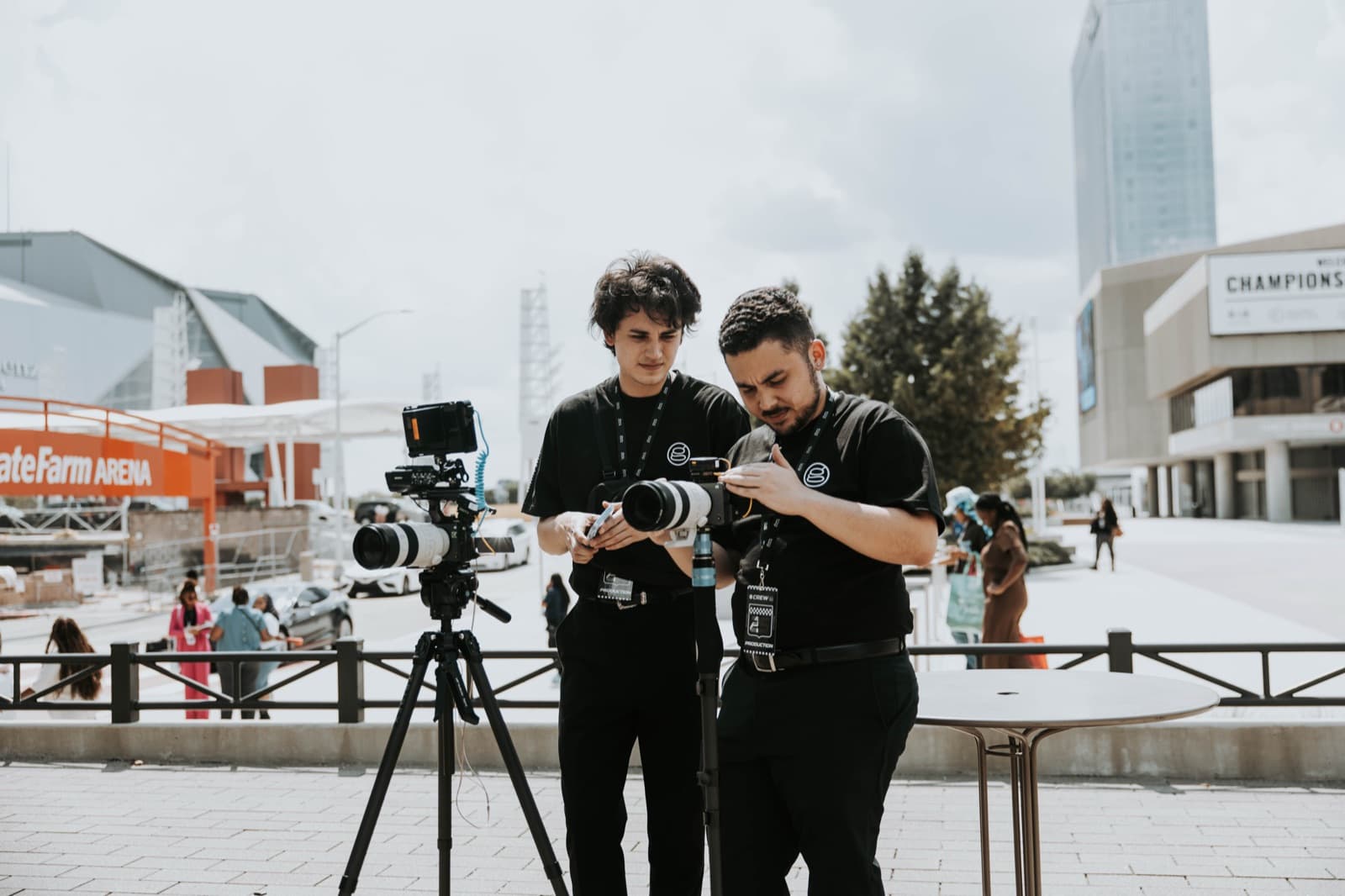
The best location is the one that helps the story and removes avoidable risk.
A beautiful office can be a terrible place to record an interview. A plain studio can become almost any environment with the right design. A busy factory floor may create production headaches and still be the only place that makes the claim believable.
Start with what the audience needs to see.
When a studio is the better choice
You need clean sound
Heating systems, elevators, traffic, refrigerators, open offices, nearby meetings, and people walking through a space can interrupt interviews.
A studio gives the team more control over the sound environment. That matters for executive interviews, podcasts, training, voice-heavy content, and any schedule with several speakers.
You need consistent light
Sunlight moves. Clouds change. Office windows create reflections and color shifts. A studio lets the crew build the look once and repeat it across the day.
That consistency is useful for:
- recurring content
- several executives
- a course or training library
- product demonstrations
- teleprompter work
- a series that needs to match over time
You need privacy
Some messages require a closed set. A studio can reduce interruptions, protect confidential material, and give a nervous speaker fewer distractions.
You need an efficient schedule
A prepared studio can reduce location scouting, furniture moves, access coordination, weather risk, and company moves. The crew still needs setup time, but the environment is designed for production.
You want to build a world
Sets, backdrops, practical furniture, projection, and LED environments can create a specific visual language without traveling to several real places.
A studio is especially helpful when the production needs several looks in one day or a background that does not exist in the real world.
When a real location is the better choice
The place is part of the proof
A hospital, campus, workshop, restaurant, warehouse, church, office, lab, or community space can tell the audience something before anyone speaks.
When the video claims that a team works a certain way, filming the real process can be more persuasive than describing it on a set.
The people are more comfortable there
Employees and customers may speak more naturally in a familiar environment. Real activity can also give the interviewer better questions and the editor richer details.
You need real B-roll
If the story depends on a product, service, environment, or customer experience, location footage may be essential.
The brand has a recognizable place
Some spaces are part of the company's identity. Filming there can carry history, community, or a sense of scale that would be hard to rebuild.
The hidden costs of location shooting
A real location may be free to use and still add production cost.
Look at:
- scouting
- permits and agreements
- parking and load-in
- security or escorts
- power
- sound control
- window treatment
- furniture moves
- production holds on the space
- customer or employee disruption
- weather
- travel between locations
- cleanup and reset
- limited working hours
An office conference room can take longer to turn into a usable set than a studio rental would have cost.
That does not make the office a bad choice. It means the comparison should include the whole production day.
The hidden costs of studio shooting
A studio solves many problems. It can create new ones when the story needs a real environment.
Consider:
- rental time
- set design or dressing
- transporting people and products
- building believable context
- access to real operations
- LED, projection, or specialty operator needs
- food, parking, and guest logistics
A studio interview with no visual connection to the work may feel generic. The production may need location B-roll, photography, screens, props, or graphics to connect the story to the real work.
A quick decision matrix
| Project need | Studio | Location |
|---|---|---|
| Clean interview sound | Strong advantage | Depends on environment |
| Repeatable lighting | Strong advantage | More variables |
| Real process or customer experience | May need supporting footage | Strong advantage |
| Several speakers in one day | Efficient | Depends on access and room |
| Privacy | Easier to control | Depends on business activity |
| Weather protection | Strong advantage | Exterior work needs backup |
| Authentic environment | Must be designed | Already present |
| Fast set changes | Possible with planning | Often slower across rooms or sites |
| Product or machinery in place | May require transport | Strong advantage |
| Recurring series | Easy to repeat | Continuity can be harder |
The hybrid plan is often strongest
A common approach is:
- Record interviews in a controlled studio or quiet prepared room.
- Capture real B-roll at the workplace, event, campus, or customer environment.
- Build the final story with both.
This gives the speaker a calm interview and gives the audience the proof of place.
Another hybrid uses an LED stage or projection environment for scenes that would be expensive, weather-dependent, or difficult to access, then combines those scenes with practical footage.
The choice should serve the story. Technology is useful when it removes a real constraint.
Questions to ask about a location
Before committing, check:
- Can the crew access the space when needed?
- Is there a loading area or elevator?
- Where can cases and equipment live?
- What does the room sound like with the HVAC on?
- Can nearby work pause during interviews?
- Is there enough power?
- Can windows or overhead lights be controlled?
- Are releases, permits, or insurance certificates required?
- Will confidential information be visible?
- Can furniture move?
- Is there a quiet holding area for speakers?
- What happens if weather changes?
- How long will reset and cleanup take?
Record a phone video and a minute of room sound during the scout. The sound sample can reveal more than a set of wide photos.
Questions to ask about a studio
- What is included in the rental?
- How much time is needed for load-in and load-out?
- Which crew or operators are required?
- What lighting, sound, grip, and power are included?
- Are sets, furniture, green rooms, or makeup areas available?
- What are the current occupancy and insurance requirements?
- How are overtime and cleanup handled?
- What is the parking and guest process?
- Can the studio support the planned number of looks?
- Who handles current pricing, specifications, and facility rules?
Griffith Media offices inside Big Screen Studios in Richardson and serves as its in-house creative and production agency. Griffith handles strategy, creative, crew, production, and post. Big Screen Studios is the direct source for facility-only tours, pricing, memberships, offices, and current room specifications.
What this means for your shoot
Choose the environment after you choose the story.
A studio gives you control. A location gives you context. A hybrid plan can give you both without forcing every part of the production into the same room.
Scout the real constraints, compare the full cost, and put the audience's experience ahead of the novelty of the space.